APPLIED LINGUISTICS for BA Students in English
VISUAL, AUDIO, AUDIO-VISUAL AND DIGITAL AIDS
Audio-visual means of education and approaches to video-production
In the history of the development of language teaching methods, Direct and Audio-Lingual Methods were followed by Audio-Visual Method as an outcome of research inquiring how effective teaching and learning can be depending on the resources used. If the input is given by audio-visual means, i.e. seeing and hearing is involved, 50% of the information gained will be stored in the long-term memory. The efficiency can be increased up to 70 % if the audio-visual imputes accompanied by students’ oral production. Originally sound-slides, ‘book cassettes’, sound-films and educational television were used. The best practice of applying traditional audio-visual means has been implemented by contemporary teachers who use videotapes, DVDs and any other audio-visual digital sources (like Flash-presentations) to facilitate language learning.
The classification of videos to be integrated in the language education procedures is the same as those of audios, i.e. authentic videos, authentic videos republished for language teaching purposes, private authentic videos recorded for language teaching purposes, educational authentic videos and videos published for language teaching.
The process of applying video-materials for receptive purposes
Possible technical solutions of screening
• freeze-frame
• sound off (picture only)
• image off (sound only)
• key-hole, masking and shading techniques
• slow motions
• speeded-up motions
A. Pre-medium stage: Exercises before watching the video-source
➣ Guessing the topic of the video-source based on
o some key words or expressions
o some text related to the topic
o some noises or music
o a limited visual impression
▪through a key-hole
▪due to shading
▪due to masking
➣ Prediction of the rest of the video-source based on
o some key words or expressions
o some text related to the video-source
o some noises or music
o a limited visual impression
▪through a key-hole
▪due to shading
▪due to masking
➣ Collecting words and expressions related to the topic the video- source covers
B. Active stage: Exercises to be used while watching the video- source
➣ Collecting words and expressions related to the video-source
➣ Elaborating on the (new) vocabulary with the help of a mono- and/or bilingual
dictionary
➣ Paraphrasing (new) words and expressions in individual student work and/or in pair-
work with peer(s)
➣ Collecting pieces of information related to particular criteria
➣ Matching
o pictures illustrating the topic of the video-recording with words
o pictures illustrating the topic of the video-recording with data and/or names of
people / places / events
o pictures illustrating the topic of he audio-recording with parts of text
o …
➣ Labelling a visual (picture, map, plan, scheme, etc.) with
o words and/or expressions
o pieces of information / data / names
o parts of text
o … etc.
➣ Multiple choice (test-like) exercises
➣ Gap-filling
➣ Completion of text
➣ Sequencing
o (key)words and expressions
o data
o names of people / places / events
o parts of text
o … etc.
➣ Correcting information
➣ Responding to yes-or-no questions
➣ True-or-false / Wrong-or-right / Double choice (test-like) exercises
➣ Responding to Wh-questions
➣ Filling in charts or tables
➣ Putting parts of text together (puzzles)
C. Follow up stage: Exercises for the period after watching the video-source
➣ Discussing issues raised by the video-source
➣ Acting out a story as suggested in the listening material
➣ Creating and acting out a continuation to the story
➣ Role-plays, simulations, drama
➣ Project-activities
o Writing a diary
o Writing a letter and/or a post-card
o Writing an article / report for a newspaper / magazine / webpage
o Writing a script for a drama or film
o Creating comics
o Producing a radio-play or any genre of radio- programs (audio-project)
o Producing a film or any genre of tv-programs (video-project)
o Writing advertisements
o Creating a board-game
o Creating a riddle / cross-word puzzle
o …
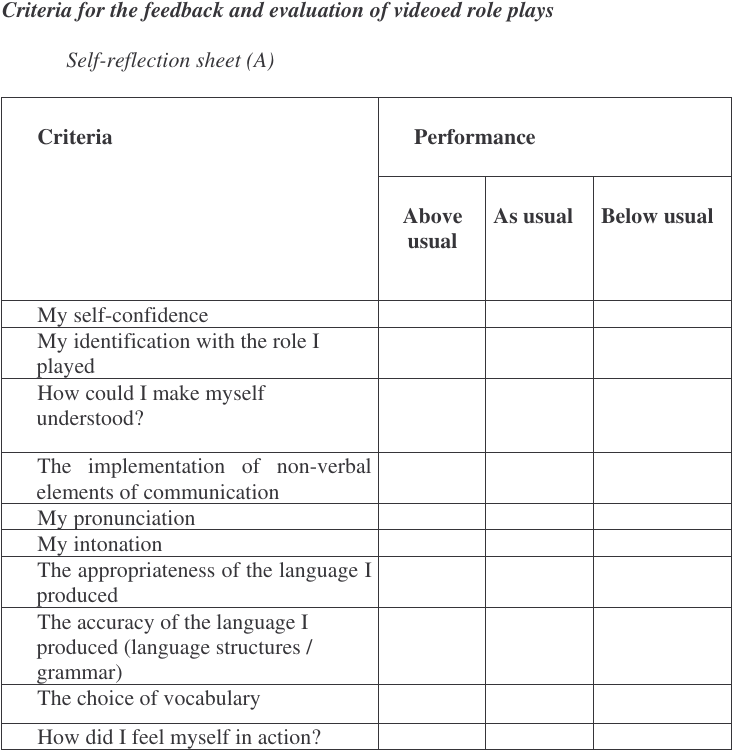
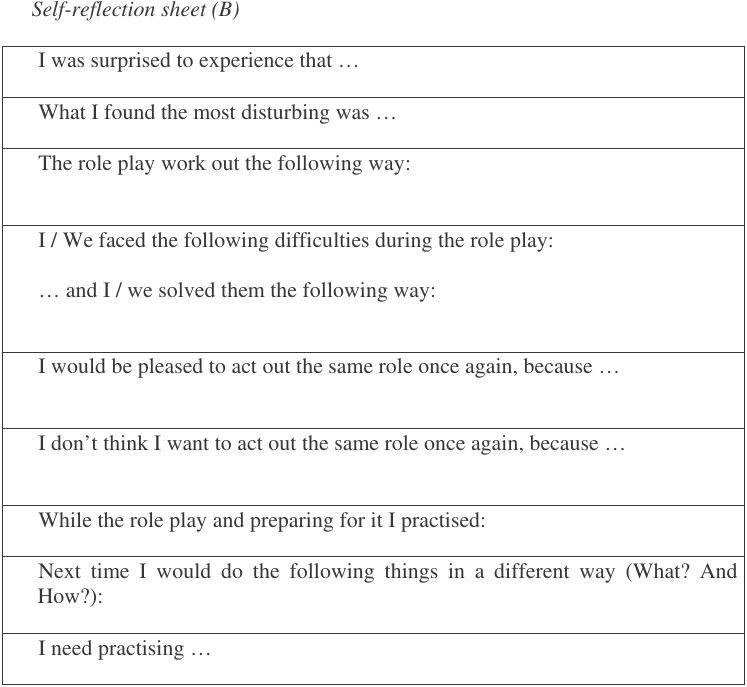
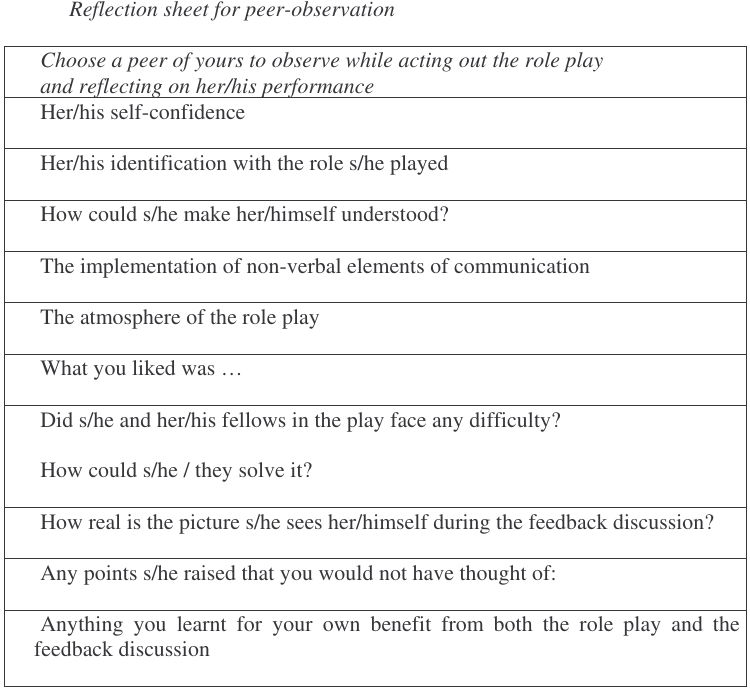
The advantage of video-technology is that one can record students’ performance, too. As mentioned before regarding audio-production, recordings can be used for feedback – self-evaluation – purposes and in project work, too.
As far as video-project work is concerned, it can aim at the production of television programs such as news, weather forecasts, sports ‘transmissions’, quizzes, advertisements and commercials, traffic information, portraits of people, ‘feature films’, soap operas, TV-sketches, situational comedies, documentary films (introducing places, traditions, past events, nature, etc.), fashion shows, puppet shows, bedtime stories, video-clips, promotion videos (introducing the work and life of an institution or a company. Further genres could be video guides of a town or of an institution like a school; video documentation of family, school and community events; ‘video letters’ to friends abroad.
It is usually role plays and isolated pronunciation exercises that can be recorded with the aim of peer-, teacher and self-evaluation. Various procedures have been elaborated to support this idea. (Lonergan, 1984, Poór, 1997)
The process of applying the video-feedback technique with role-plays
A. Preparatory stage: before the role play
1. Setting the objectives and deciding on timing, time- frame, topic, forms
2. Planning
3. Implementing lead-in (bridging) activities
B. Active stage: while students act out the role play
4. Setting tasks
5. Learners prepare for the role play
6. Acting out the role play and recording it with a camera
C. Follow-up stage: after the role play
7. Feedback: analysis and evaluation of learners’ performance by the learners involved, their peers and the teacher by replaying the video-recording
8. Reflection on the whole process by the learners and their teacher