A social realist approach to research in applied linguistics
Social realist research: an applied linguistic example
Research into social processes whose primary focus is the domains of situated activity and social settings is sometimes labelled 'middle range research'. Thus research into the learning of additional languages in educational settings can be thought of in these terms. As it is Pawson who has developed the most explicit model of a realist research program intended for those interested in carrying out middle range research, we shall draw heavily on his work in what follows. It should not be forgotten, though, that the 'strata', 'domains' or 'nested dimensions' are not conceived of as either hierarchical or impermeable, and will all be implicated in social interactions, whatever the primary focus.
This recognition, again, is implicit in studies which set out to investigate macro differences at the local level. For example, there is a widespread belief that foreign language teaching in the UK is not as successful as it is elsewhere. (See for example the Nuffield Foundation 2000, and a 'green paper' published by the UK government, which states 'We have not in the past taught languages as successfully as many other countries'.) One response of researchers is to look closely at what goes on in foreign language classrooms (e.g. Mitchell 2000). Or teachers of English to foreign learners notice that those in some countries have much less difficulty obtaining high scores on the standardized tests such as IELTS than those in other countries. Research studies aimed at investigating this large-scale phenomenon frequently involve observation and analysis of tiny numbers of nationals from each country, and may use the much more local, accessible data of interactions between learners and teacher, or the texts (such as, in our earlier example, business letters in the target language, English) produced by a 'sample' of learners in each group. Such research designs are operationally 'middle-range', but are rarely explicit about the processes which link the macro concern - the English education system's achievement in teaching and learning foreign languages/the differential average IELTS scores of, say, Greek and Korean learners - with the micro, more observable manifestation of that concern - features of these particular teachers/learners/ syllabuses/teaching styles/texts.
We shall assume a prototypical research problem, derived from these applied linguistic concerns, which we couch in fairly general terms to encompass issues such as those sketched out in the preceding paragraph. So the research question we consider here, is 'Why, on a standardized L2 test, do students in Group A achieve consistently better than students in Group B?', where belonging to either group may mean being taught in a specific country, or by a specific method, or being male as opposed to female and so on. We shall use this question to illustrate our modified version of Paw-son's model, a model which contains a series of stages, and which we have represented diagrammatically in Figure 8.1.
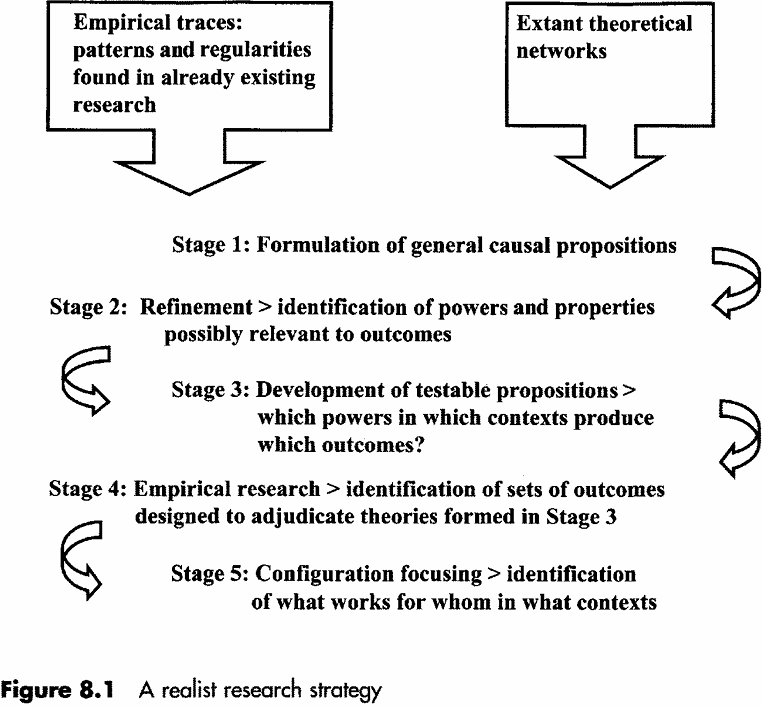
Firstly, the researcher tries to formulate general causal propositions, on the basis of prior empirical research. What does existing research suggest might be leading Group A students towards consistently better achievements in language learning than Group B students? In Byrne's terms, this investigation consists of the identification and classification of the 'traces' left by real social processes.
The causal propositions generated are necessarily formed within the extant networks of theory. Adopting the modified version of Pawson's approach would start from a recognition, contra the empiricist alternative, that it is not the world - directly - that informs the causal propositions formulated at this stage. Therefore, this approach does not seek to identify either 'the typical case' or 'the representative case' as variables-based research seeks to do, thereby subscribing to a theoretical claim (though it is often not explicitly acknowledged as such) that the empirical world is 'given'.
A review of the existing literature might point to a significant role for, among other things, 'motivation' in the differential achievements of the two groups: studies which suggest that many English school students in an increasingly anglophone world are not motivated to study a foreign language, for example, or those which find that student-centred teaching styles motivate learners more, and so on. Traditional approaches might then 'factor in' motivation as a variable, but for Pawson and Tilley, in contrast, motivation is reconceptualized in terms of the complexity of constrained choice in a structured context.
In the second stage of Pawson's research design, when some causal propositions have been identified, the researcher seeks to refine these by simplifying them to an essential core of attributes. The goal at this stage is the identification of powers and properties, with a view to investigating whether it is the realization of these that produces the outcomes under examination. Having proposed general causal propositions - for example, that high motivation in L2 learning is associated with the kind of teaching encountered, or with the long-term utility of the L2 for the learner - the next question concerns what powers and properties are involved in the development of motivation generally. The realist explanation would consider the powers and properties of agency, structure and culture, and consideration of agency in relation to motivation would point to intentionality - or purpose — as a core 'power' of human beings. It is a distinctive characteristic of human beings that they have reflexivity, the ability, through self-consciousness, to attain a degree of objectivity towards themselves in the world, and therefore not simply to be determined by the world and their instincts. This power leads to the possibility of making decisions among a range of possible choices, and 'motivation' is involved when one course of action is perceived as more desirable than another. The realist's stratified ontology, however, requires consideration of the properties of social structure which act to constrain or enable human intentions. So while learners' assessment of the probability of being able to make use of the L2 may also be involved in motivation, that probability is associated with more macro structural factors such as the global economy, and the likelihood that facility in this particular L2 will lead to secure employment. 'Motivation', then, is conceptualized not as an individual characteristic, nor as a quantifiable variable possessed in different measures by different learners, but as emergent from relations between human intentionality and the social world:
Without doubt, the interpretive work that individuals do to give direction and substance to social encounters is extremely important, but acknowledging this should not blind us to the part played by the wider social context of positions and locations in which the individual is embedded. Clearly these more encompassing social relations of domination and subordination play a significant role in constraining, as well as enabling, certain forms of behavior and activity. It is therefore important that field research attempts to incorporate these features.
It is important, too, to note that the impact of structure on agency is not unidirectional: '... systems that "contain" other systems are as potentially liable to be influenced by those contained, as the contained are to be influenced by the container' (Byrne 2002: 33). In this example, if disaffection is demonstrated by a significant proportion of learners, this may well have the effect of altering the context in which some new teaching approach is tried out. Then, learner motivation and teaching style may interact with each other in a sequence which becomes increasingly different from a parallel sequence emerging where the same innovation is also under trial in a neighboring context. For instance, English school students who opt in sufficiently large numbers not to study foreign languages may thereby exert an influence on the distribution of resources to this curriculum area, teaching posts, departments in universities and so on, so that Modern Foreign Languages as a school subject has very different characteristics in England from the equivalent subjects in other European countries.
Because language learning is not simply a matter of motivation, of course, this stage of the research design would also include specification of other important powers and properties, such as 'what needs to be present for people to learn (additional) languages at all?' Answers to this question, again, entail taking account of all the domains of the social world, and include not only the human physiological capacity for language acquisition, but also contextual resources such as access to tuition, the social setting of a productive teaching environment, as well as the situated activity of teaching interactions themselves.
The third stage of Pawson's research design is the selection of a conceptual orientation or analytic framework. Returning to the example of motivation, a realist ontology will rule out, for example, those approaches which see it as a fixed trait, because, as we have observed, human reflexivity and purpose are adaptive and motivation is emergent, nonlinear, and subject to feedback mechanisms which can change it. Conversely, it will incline the researcher towards frame-works which are able to accommodate processes of change and emergence.
On the basis of this framework, the researcher then seeks to build up series of testable propositions, framed in terms of outcomes which are emergent from the engagement of powers and properties with contexts. That is, propositions are formulated as suggestions about which things - in combination with each other - in which circumstances, result in the particular outcome under review. We would also be seeking to distinguish the necessary from the contingent. In relation to our example research problem, then, drawing on Bourdieu's claim (1986) that cultural capital shapes the contexts in which social agents act, and the studies which he and others have conducted to investigate these ideas, we might propose at this stage that successful learning of the L2 is an emergent product of cultural capital in combination with a cultured habitus and learners' motivation.
This brings us to the next stage, and the first phase of empirical research. The important feature of empirical work in this realist approach is that it does not set out to refute hypotheses by direct appeal to empirical reality. Rather, data collection and analysis are primarily directed towards testing, refining and adjudicating the middle range theories produced in the previous stage. In this phase we identify as many sources of information as we can in order to develop as rich as possible a set of outcomes. So research investigates distributions of the successful L2 learners (those in 'Group A') in relation to various features of social contexts, exploring whether there are any marked characteristics associated with being in this group, such as age, skin color, sex, nationality, religion and so on; or, returning to 'motivation', are there consistent patterns among the successful learners' reasons for taking L2 classes? The methods to be used here would be adapted to these questions, probably involving quantifying data such as test results as well as interviewing learners about their aspirations and preferences. The outcomes identified at this stage represent the regularities which form the raw material to be explained: that is, they do not constitute the end-point or 'findings' of the research.
The final stage in the first cycle of this realist approach to researching the original problem is that of 'configuration focusing', where we begin to answer the question of 'what works for whom in what circumstances?' Pursuing our illustrative research problem in these terms, let us suppose that investigation of the data demonstrates that a particular style of teaching is associated with successful outcomes (enhanced L2 attainment) at least for some learners - perhaps for most of the females in the group, but only a small proportion of the males. In many studies, the findings would be presented at this point, with an indication of the strength of correlation between these variables. And of course, another study might be published from another researcher which provides counter evidence. What does the realist researcher do? Since we are not seeking to generate covering laws, but rather to develop an explanatory account of social action, we are not confounded by inconsistencies across replicated and near-replicated studies; instead, the next move is a return to the theoretical drawing board. The challenge at this point is to refine the causal hypotheses, to try to explain what contextual features are operating to suppress the realization of those properties and powers identified as causally effective in other contexts or for other learners.
In our hypothetical example, some further interpretive study, such as close observation or interviews, might identify a sub-group of several male and some female learners in the 'student-centred' class room who find aspects of the social setting in which learning takes place 'demotivating'. Perhaps there is a conflict between winning peer group approval as an adolescent boy and displaying fluency in a foreign language (Barton 2000). Or perhaps the impact of international conflict has led to an increase in racist responses to particular groups of learners, so that some of them in turn begin to develop more negative attitudes towards a target language associated with their detractors. This points to the need to include the most abstract 'domains' of social life (contextual resources) in our causal account of successful L2 learning, and the causal proposition would be further refined. Psychobiographical differences, too, would almost certainly influence different learners in different ways, so that what amounts to a demotivating context for one learner may be an inspiring one for another. The approach avoids reduction to the ideographic, however, because by and large, given the structured contexts of the social world, there will be the patterned regularities identified in the earlier stages of the research process: communities of practice are far-from-equilibric, dynamic systems, constantly perturbed by feedback mechanisms of various kinds. The result of the research cycle is not a 'master theory' of the key causal mechanism, nor a catalogue of inconsistent results, but a typology of broadly based configurations.








