The Impact on Teachers of Language Variation as a Course Component
RESULTS
Views of Language Variation and Language Planning Topics
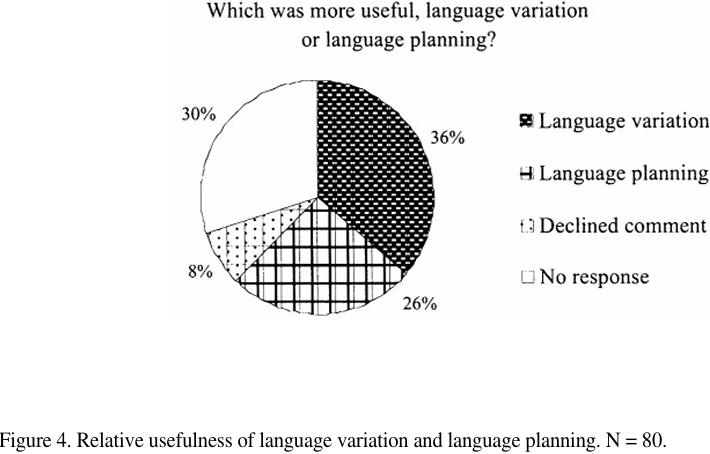
Respondents rated each of the ten sociolinguistics topics in relation to five statements giving possible opinions of the topics, indicating on a four-point scale whether they strongly agreed (4), agreed (3), disagreed (2) or strongly disagreed (1) with each statement. The mean scores for each topic are presented in table 2 overleaf. (Note: The sub-group who had earlier indicated language variation to be most useful returned higher mean agreement values for the five language variation topics than did the language planning supporters. The reverse was true for the five language planning topics.iv )
In general, interest in all the topics is encouragingly high (s for the ten mean rating SD = 0.2), with Cross-Cultural Communication being of particular interest to all respondents. (mean rating = 3.6). Language and Gender provoked the least positive response (mean rating = 3.6). Language and Gender provoked the least positive response (mean rating 3.1), with one teacher commenting ‘I am tired of hearing about sexism in the English language...’
The issue of relevance receives a slightly more mixed response (SD = 0.3), with ‘Cross-Cultural Communication’ again receiving the highest mean rating (3.5). Two of the comments go some way towards explaining how variation topics may be relevant or not: ‘I view “cross-cultural communication” with particular interest because of the way I have come to see culture as “encoded” in the language,’ and ‘Learning about creoles and pidgins was fascinating, but I highly doubt that I would cover the subject in class, since my students (Finns) don’t deal with any one part of the world in English as they might if I was teaching in Singapore.’
None of the topics were felt to be unduly hard to understand. In this case, an exceptionally high level of agreement with the prompt statement would have been as worrying as a very low score, as it would suggest that the materials were not challenging course participants sufficiently. Responses to the fourth statement, which proposed that all the ideas presented were new, revealed that ‘Accent and Dialect’, ‘Language and Gender’ and ‘Cross-Cultural Communication’ were the most familiar topics, but mean agreement ratings for even these, at 2.4 or higher, suggest that there was sufficient new material for most students.
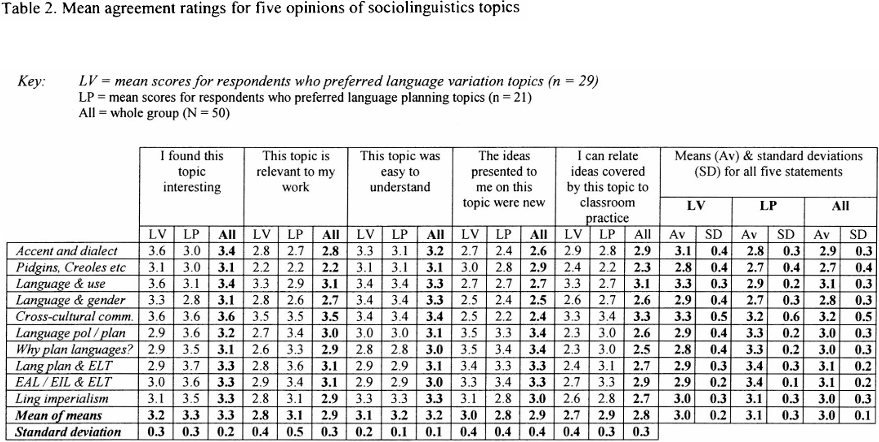
The final prompt asked if topics related to classroom practice. Here we find Pidgins, Creoles and New Englishes get a low mean score (2.3), with Cross-Cultural Communication rated as the most clearly related to classroom practice (3.3). Language and Use / Register creates some disagreement, probably because this seems to relate well to classroom practice only in certain situations, e.g. one teacher says, ‘my students are lower-level. Some of these things can be seen in principle but they don’t affect my day-to-day teaching much’, possibly implying that lower-level students do not need to learn different registers.
iv The z-score for the two sets of 50 means = 7.2, well in excess of the critical value of 1.6 for a non-directional z-test at p ≤ 0.05, demonstrating there is indeed a significant difference between the two subgroups.








