The circumstantial roles associated with the process
These include the well-known circumstances of time, place, manner and condition, as well as a few others. They are typically optional in the semantic structure, just as their adjunctive counterparts are in the syntactic structure. Circumstances can, however, be inherent to the situation: for instance, location is obligatory with certain senses of ‘be’, as in the ice-cream’s over there, and with ‘put’ in its sense of ‘placing’ as in let’s put it in the freezer.
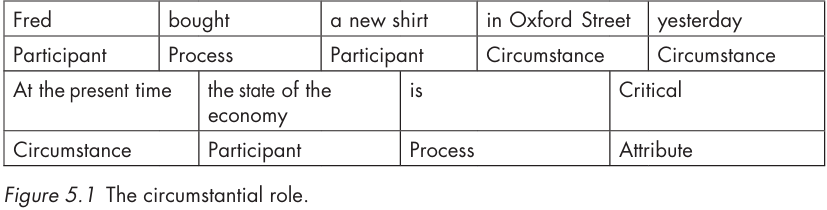
We have now outlined the framework that will serve to carry the different configurations of semantic functions that go to make up semantic structures. It is not the case, however, that any particular configuration is inherently given in nature. There are various ways of conceptualizing a situation, according to our needs of the moment and what the lexico-grammatical resources of a language permit.
For instance, on the day planned for a river picnic we may look out of the window and say it’s cloudy, specifying simply a state (is) and an Attribute (cloudy); alternatively, that the sky is cloudy, adding a participant (the sky) for the Attribute. More ominously, someone might say the clouds are gathering, in which the situation is represented as a dynamic happening rather than as a state, with a participant (clouds) and a dynamic process (are gathering), leaving implicit the circumstance of place (in the sky).
There is no one-to-one correlation between semantic structures and syntactic structures; rather, the semantic categories cut across the syntactic ones, although with some correlation. Semantic structures and syntactic structures do not, therefore, always coincide; rather, they overlap. In both cases, however, it is the process, expressed by the verb, that determines the choice of participants in the semantic structure and of syntactic elements in the syntactic structure. The possible syntactic combinations are discussed from the point of view of verb complementation and verb type. We shall start from the semantics; at the same time we shall try to relate the choice of semantic roles to their syntactic realizations.
One obvious problem in the identification of participants and processes is the vastness and variety of the physical world, and the difficulty involved in reducing this variety to a few prototypical semantic roles and processes. All we can attempt to do is to specify the paradigm cases, and indicate where more detailed specification would be necessary in order to account semantically for the varied shades of our experience.








