What is Morphological Productivity?
To say that a given morphological pattern is more productive than another is to say that there is a higher probability of a potential word in the first pattern being accepted in the language than there is of a potential word in the second pattern. We illustrate this with a simple example from English: plural formation. English nouns make their plural in a number of different ways, as can be seen in the following set of words (Bauer 2001: 2):
(2) cats, dogs, horses, oxen, deer, mice, hippopotami, cherubim
In light of all of these ways to mark nouns as plural, what does a speaker of English do when confronted with novel words, such as those in (3)?
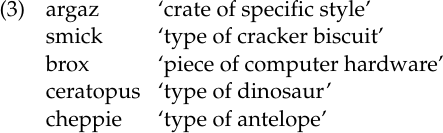
Chances are that, despite the existence of other plural formations, an English speaker will mark all of these words as plural by suffixation of /z/: argazes, smicks, broxes, ceratopuses, and cheppies. The only likely exception is ceratopus, which could plausibly be given the plural ceratopi, on the basis of Latin borrowings such as alumni, foci, and nuclei.1
Bauer (2001: 3), to whom we owe the set of words in (3), selected them very carefully. The word argaz ‘crate’, for example, is in fact a Hebrew noun. It would therefore be possible to pluralize it as argazim, on the pattern of cherubim, seraphim, and kibbutzim. But this special plural would require that the speaker be familiar with the Hebrew plural and that this type of crate be connected somehow with Judaism. Bauer chose the word brox ‘piece of computer hardware’ because it rhymes with ox and because for some, the computer called a Vax (manufactured in the 1970s) was pluralized as Vaxen (presumably on analogy to oxen). Thus, there would be a precedent for pluralizing brox as broxen. Even so, the layperson would almost certainly pluralize these two words as broxes and Vaxes. To return to the statement in (1a), “Though many things are possible in morphology, some are more possible than others,” the English /z/ plural is more productive than other existing plural formations because there is a higher probability that speakers will accept and create forms like argazes and broxes (and prouses, meers, and vilds) than argazim and broxen (and price, meer, and vildren, cf. mice, deer, and children).
One term we will be using a lot is potential word. A potential word could be a word but isn’t. One example is Mugglehood ‘the state of being a non-wizard’, which we created from Muggle ‘non-wizard’, a word found in J. K. Rowling’s Harry Potter books, and the English suffix -hood. Mugglehood isn’t defined in the dictionary, and it probably is not in your working vocabulary. But when we first did an online search for it in 2004, we found not only three instances of Mugglehood, but also numerous instances of Muggledom and Muggleness. (When we searched for it again on January 3, 2010, we got 292 hits, including the first edition on Google Books.) Apparently, we are not alone in thinking Mugglehood a potential word. For some speakers, it has already passed from being a potential word to being an actual one. Perhaps someday it will be included in the dictionary.
The suffix -th creates nouns from adjectives (e.g., deep → depth, wide → width). It has a meaning that is similar to -ness. Length means the same thing that longness would mean if it were a word; if you could say decidedth, it would mean the same thing as decidedness. But only -ness can be called productive. In fact, no word in -th has successfully been integrated into standard written English since the coining of width in 1627. People have certainly tried, coming up with words like greenth, illth, and lowth. But they have not been very successful. Speakers of standard English simply don’t accept new coinages in -th.
When we study productivity, we study phenomena and distinctions like these. One question we need to ask about productivity is whether it is part of linguistic competence. Competence is Chomsky’s (1965) term for the knowledge that speakers and hearers have of their language. It contrasts with performance, or how the language is actually used in concrete situations. In actual performance, a speaker may hesitate, stop in mid-sentence, or make one or another slip of the tongue. But a linguist, in studying the language, would not regard such hesitations, half-sentences, and speech errors as part of the language. That is not to say that these phenomena should be ignored. Slips of the tongue have provided great insights into the general structure of language. And code mixing, a type of linguistic performance in which fluent speakers of two or more languages mix these languages freely in mid-sentence in conversation, is an area of active research. Though slips of the tongue and code mixing are not linguistic competence, but rather linguistic performance, both can still be studied fruitfully for what they tell us about language.
Some people would say that productivity is not part of linguistic competence either, because, in order for something to be considered part of competence, it must be structural and ‘all or none’. Productivity is a probabilistic notion, as we will see, and some linguists believe that if something is probabilistic, it is not structural and hence is not part of the grammar. Under this view, productivity would have to be treated as a phenomenon that is related to a speaker’s competence, but not part of it.
The alternative position, and the one we take here, is that if speakers are sensitive to productivity, and if it is part of what they do with language and not just a factor that influences language, then it is part of their linguistic competence. The question of whether it is structural is simply not important. If we let ideology get in the way of linguistic investigation, then we will miss out on important generalizations. Moreover, while productivity itself is not structural, it is very easy to show that it has structural effects that may turn out to be relevant to structural theories of language.
1 Whether or not a Latin noun makes its plural in -i generally depends on its declension type. That is why we find choruses, campuses, and geniuses next to alumni, foci, and nuclei. Though people often pluralize syllabus as syllabi, this was not its Latin plural. It was a fourth declension noun, meaning its plural was syllabūs. Ceratopus is in fact not even Latin in origin, but instead Greek. The final syllable (-pus) is the same Greek root meaning ‘foot’ that is found in octopus. The etymologically correct plural is therefore ceratopodes, similar to the etymologically correct plural of octopus, which is octopodes, though most people think it should be octopi or octopuses.








