Grammar
Tenses
Present

Present Simple
Present Continuous
Present Perfect
Present Perfect Continuous
Past
Past Simple
Past Continuous
Past Perfect
Past Perfect Continuous
Future
Future Simple
Future Continuous
Future Perfect
Future Perfect Continuous
Parts Of Speech
Nouns
Countable and uncountable nouns
Verbal nouns
Singular and Plural nouns
Proper nouns
Nouns gender
Nouns definition
Concrete nouns
Abstract nouns
Common nouns
Collective nouns
Definition Of Nouns
Animate and Inanimate nouns
Nouns
Verbs
Stative and dynamic verbs
Finite and nonfinite verbs
To be verbs
Transitive and intransitive verbs
Auxiliary verbs
Modal verbs
Regular and irregular verbs
Action verbs
Verbs
Adverbs
Relative adverbs
Interrogative adverbs
Adverbs of time
Adverbs of place
Adverbs of reason
Adverbs of quantity
Adverbs of manner
Adverbs of frequency
Adverbs of affirmation
Adverbs
Adjectives
Quantitative adjective
Proper adjective
Possessive adjective
Numeral adjective
Interrogative adjective
Distributive adjective
Descriptive adjective
Demonstrative adjective
Pronouns
Subject pronoun
Relative pronoun
Reflexive pronoun
Reciprocal pronoun
Possessive pronoun
Personal pronoun
Interrogative pronoun
Indefinite pronoun
Emphatic pronoun
Distributive pronoun
Demonstrative pronoun
Pronouns
Pre Position
Preposition by function
Time preposition
Reason preposition
Possession preposition
Place preposition
Phrases preposition
Origin preposition
Measure preposition
Direction preposition
Contrast preposition
Agent preposition
Preposition by construction
Simple preposition
Phrase preposition
Double preposition
Compound preposition
prepositions
Conjunctions
Subordinating conjunction
Correlative conjunction
Coordinating conjunction
Conjunctive adverbs
conjunctions
Interjections
Express calling interjection
Phrases
Sentences
Clauses
Part of Speech
Grammar Rules
Passive and Active
Preference
Requests and offers
wishes
Be used to
Some and any
Could have done
Describing people
Giving advices
Possession
Comparative and superlative
Giving Reason
Making Suggestions
Apologizing
Forming questions
Since and for
Directions
Obligation
Adverbials
invitation
Articles
Imaginary condition
Zero conditional
First conditional
Second conditional
Third conditional
Reported speech
Demonstratives
Determiners
Direct and Indirect speech
Linguistics
Phonetics
Phonology
Linguistics fields
Syntax
Morphology
Semantics
pragmatics
History
Writing
Grammar
Phonetics and Phonology
Semiotics
Reading Comprehension
Elementary
Intermediate
Advanced
Teaching Methods
Teaching Strategies
Assessment

The rise of a relative clause construction
 المؤلف:
Bernd Heine and Tania Kuteva
المؤلف:
Bernd Heine and Tania Kuteva
 المصدر:
The Genesis of Grammar
المصدر:
The Genesis of Grammar
 الجزء والصفحة:
P288-C6
الجزء والصفحة:
P288-C6
 2026-03-24
 104
104


+
-
20
The rise of a relative clause construction
As we observed in “The demonstrative channel”, the most frequent development in the languages of the world is to create a new relative clause structure via the grammaticalization of demonstrative pronouns (not attributes), and creoles have also made use of this mechanism, as we will now demonstrate with an example from the English-based creole Sranan of Suriname.1 Sranan arose in the late seventeenth century on the plantations of Suriname, which was made a British Colony in 1651; in 1668, Dutch became the colonial language. As in pidgins and newly emerged creoles, there were essentially no formally marked relative clauses in early Sranan: The English relativizers were lost, and most of the text examples that were seemingly unmarked relative clauses might also receive alternative interpretations, and there is no evidence that there was a recursive structure of relativization. Zero marking of relative clauses continued throughout the nineteenth and twentieth centuries.
For most of the seventeenth century, the demonstrative disi ‘this’ (< English this) was functioning both as a nominal modifier and a pronoun (we will refer to this as stage 0). Probably around the end of the seventeenth century, disi developed from demonstrative to relativizer within the short period of half a century, thereby giving rise to an overtly recursive structure (stage 1). In the course of the eighteenth century, disi underwent extension as an explicit relativizer. However, while disi could be understood as a relative clause marker determining the preceding noun, an interpretation of disi as a demonstrative in an independent clause could not be ruled out in most cases. However, there are eighteenth century examples such as (16), where disi was already unambiguously a relativizer.
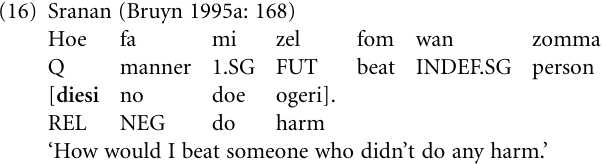
But disi underwent a further grammaticalization, namely one from relative marker to adverbial clause subordinator (CONJ): In the second half of the eighteenth century, if not earlier, its use was extended to introduce temporal, causal, and concessive clauses; cf. (17a), which illustrates its temporal, and (17b) its causal uses.
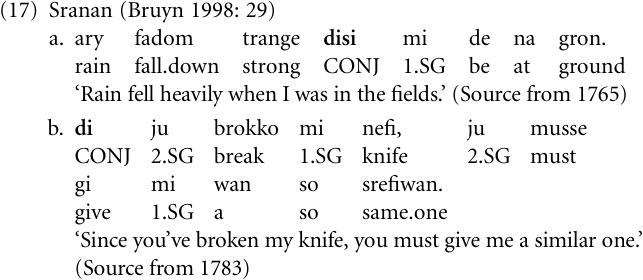
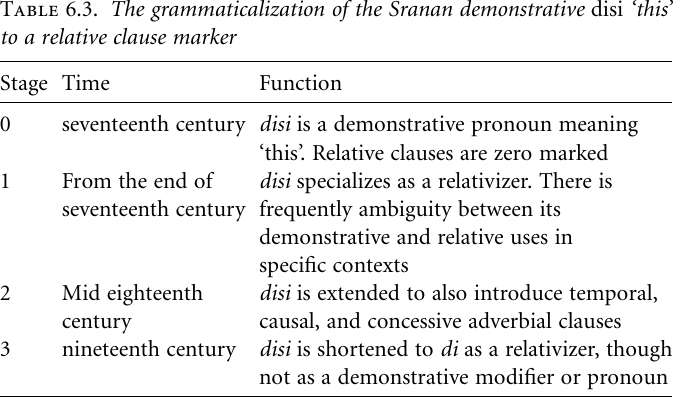
In eighteenth-century sources, the relativizer had the form disi; in the course of the nineteenth century, the new relativizer disi underwent erosion, that is, it was shortened to di, leading to the separation of demonstrative and relative marker. As example (17b) shows however, instances of erosion of disi can be found much earlier.
The whole process of the rise and development of new forms of clause subordination, however, did not mean that the original zero-marked structure was abandoned; rather, the latter survived to some extent and is still accessible today. The major stages in the development of Sranan disi are summarized in Table 6.3.
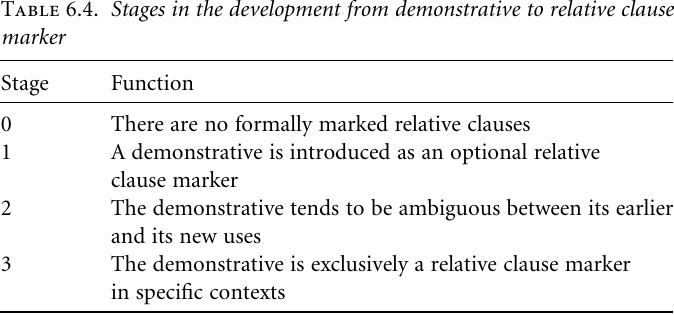
To conclude, Sranan speakers appear to have created subordinate clause structures in accordance with universal parameters of grammaticalization. A strikingly similar example was presented in “The rise of new functional categories”, involving the development of the Kenya Pidgin Swahili demonstrative ile ‘that’. As grammaticalization theory would predict, in both cases there was a sequence of stages as sketched in Table 6.4.
Accordingly, in both cases there was a demonstrative pronoun used non-recursively that was grammaticalized to a new syntactic structure, thereby giving rise to a recursive structure of clause subordination.
1 For the data on this process, see Bruyn (1995a, 1995b, 1998).
 الاكثر قراءة في Clauses
 اخر الاخبار
اخبار العتبة العباسية المقدسة

الآخبار الصحية


مواضيع ذات صلة
 قسم الشؤون الفكرية يصدر كتاباً يوثق تاريخ السدانة في العتبة العباسية المقدسة
 "المهمة".. إصدار قصصي يوثّق القصص الفائزة في مسابقة فتوى الدفاع المقدسة للقصة القصيرة
 (نوافذ).. إصدار أدبي يوثق القصص الفائزة في مسابقة الإمام العسكري (عليه السلام)