Grammar
Tenses
Present

Present Simple
Present Continuous
Present Perfect
Present Perfect Continuous
Past
Past Simple
Past Continuous
Past Perfect
Past Perfect Continuous
Future
Future Simple
Future Continuous
Future Perfect
Future Perfect Continuous
Parts Of Speech
Nouns
Countable and uncountable nouns
Verbal nouns
Singular and Plural nouns
Proper nouns
Nouns gender
Nouns definition
Concrete nouns
Abstract nouns
Common nouns
Collective nouns
Definition Of Nouns
Animate and Inanimate nouns
Nouns
Verbs
Stative and dynamic verbs
Finite and nonfinite verbs
To be verbs
Transitive and intransitive verbs
Auxiliary verbs
Modal verbs
Regular and irregular verbs
Action verbs
Verbs
Adverbs
Relative adverbs
Interrogative adverbs
Adverbs of time
Adverbs of place
Adverbs of reason
Adverbs of quantity
Adverbs of manner
Adverbs of frequency
Adverbs of affirmation
Adverbs
Adjectives
Quantitative adjective
Proper adjective
Possessive adjective
Numeral adjective
Interrogative adjective
Distributive adjective
Descriptive adjective
Demonstrative adjective
Pronouns
Subject pronoun
Relative pronoun
Reflexive pronoun
Reciprocal pronoun
Possessive pronoun
Personal pronoun
Interrogative pronoun
Indefinite pronoun
Emphatic pronoun
Distributive pronoun
Demonstrative pronoun
Pronouns
Pre Position
Preposition by function
Time preposition
Reason preposition
Possession preposition
Place preposition
Phrases preposition
Origin preposition
Measure preposition
Direction preposition
Contrast preposition
Agent preposition
Preposition by construction
Simple preposition
Phrase preposition
Double preposition
Compound preposition
prepositions
Conjunctions
Subordinating conjunction
Correlative conjunction
Coordinating conjunction
Conjunctive adverbs
conjunctions
Interjections
Express calling interjection
Phrases
Sentences
Clauses
Part of Speech
Grammar Rules
Passive and Active
Preference
Requests and offers
wishes
Be used to
Some and any
Could have done
Describing people
Giving advices
Possession
Comparative and superlative
Giving Reason
Making Suggestions
Apologizing
Forming questions
Since and for
Directions
Obligation
Adverbials
invitation
Articles
Imaginary condition
Zero conditional
First conditional
Second conditional
Third conditional
Reported speech
Demonstratives
Determiners
Direct and Indirect speech
Linguistics
Phonetics
Phonology
Linguistics fields
Syntax
Morphology
Semantics
pragmatics
History
Writing
Grammar
Phonetics and Phonology
Semiotics
Reading Comprehension
Elementary
Intermediate
Advanced
Teaching Methods
Teaching Strategies
Assessment

Analyzing position classes
 المؤلف:
PAUL R. KROEGER
المؤلف:
PAUL R. KROEGER
 المصدر:
Analyzing Grammar An Introduction
المصدر:
Analyzing Grammar An Introduction
 الجزء والصفحة:
P18-C2
الجزء والصفحة:
P18-C2
 2025-12-04
 1009
1009


+
-
20
Analyzing position classes
Let us work through the process involved in constructing a position class chart. The first step obviously is to identify each morpheme in the data, using the methods discussed in Identifying meaningful elements. We will practice with the following (slightly regularized) data from the Gee language of West Africa. For simplicity, morpheme boundaries are already marked:
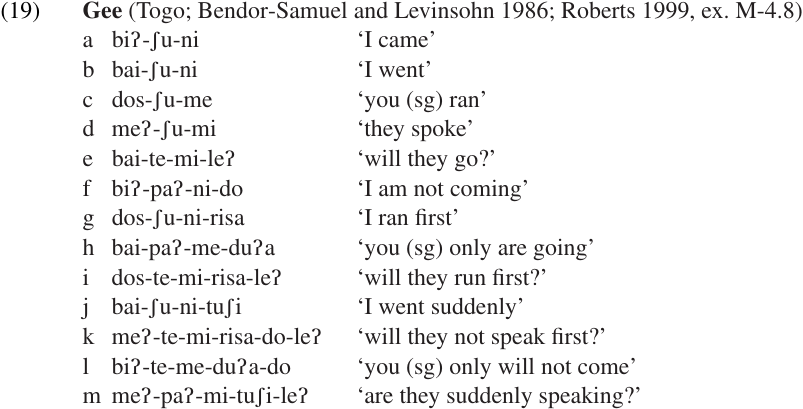
Based on these data we can identify the following meanings for each morpheme:
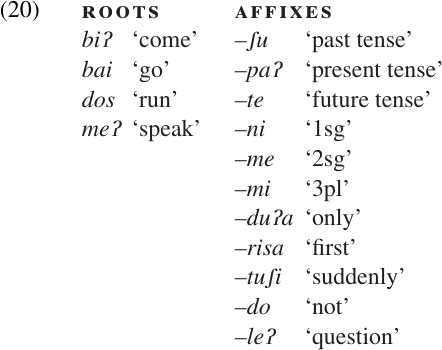
We begin the position class analysis by re-writing each word in the data onto a chart, with the longest words (i.e. those which contain the greatest number of morphemes) at the top. We line up all the roots in one column and arrange the affixes in such a way that: (i) no column in the chart contains more than one morpheme in any given word; and (ii) each individual morpheme always appears in the same column in all the words where it occurs.
One obvious way to do this is to start out with a separate column for each morpheme; in this example, that would mean 12 columns (1 for the root plus 1 for each of the 11 affixes). But it is much more helpful to make some initial guesses about which affixes might belong to the same position class. When several affixes have closely related meanings, or belong to the same grammatical category (tense, person, number, etc.), and no two of them are found in the same word, there is a good chance they will belong to the same class. In that case, we can write them in the same column in our initial chart.
The charting procedure itself will help us to find out if an initial hypothesis of this sort was mistaken. There are at least two ways in which this could happen. First, we might discover that two of the affixes which we have tentatively grouped together really can occur in the same word after all. Second, we might discover that two affixes have different ORDERING RELATIONSHIPS with respect to some other morpheme. For example, if we find in a certain language that the masculine and neuter gender markers occur as prefixes to the adjective root, while the feminine marker occurs as a suffix, we must split these elements into two separate position classes, even though they all express the same grammatical category (namely gender). This is necessary because the columns in a position class chart represent fixed linear ordering constraints. Every element in a given position class must have the same order as its fellows with respect to all elements of every other position class.
In our present example, we can see that the three tense markers (–ʃu,–paʔ, and–te) form a coherent group, as do the three subject-agreement markers (–ni,–me, and–mi); and there are no words which contain more than one element from either group. So our initial chart might look like (21).
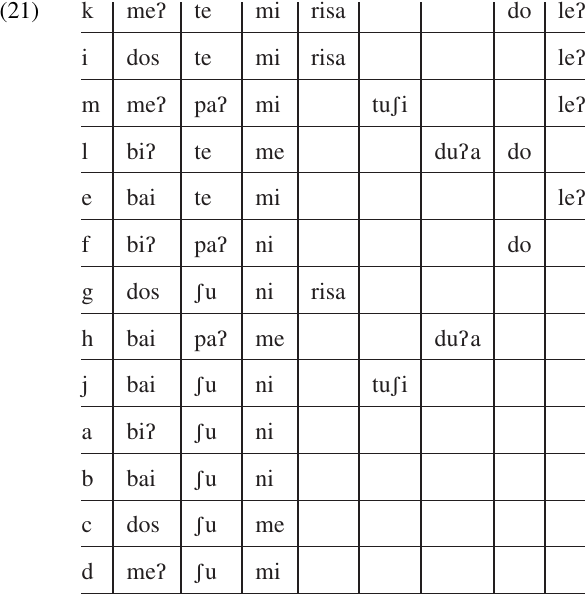
The next step is to inspect each column to see whether elements in that column ever co-occur with elements in the neighboring column to the left or right. If we find two adjacent columns that are never both filled in the same row, it would be possible to merge the two into a single column. The two sets of elements are said to be in COMPLEMENTARY DISTRIBUTION, meaning that no single word ever contains elements from both sets.
We would definitely want to merge the two columns if the meanings of the elements are related or form a coherent class in some way. On the other hand, if two adjacent columns appear to be in complementary distribution but there is no plausible relationship between the meanings of their elements, it may be better to leave the columns separate for the time being. Rather than merging the two, add a note at the bottom of your chart stating that these two sets of elements have not been found to co-occur. When you have a chance to collect more data, try to find examples where elements from both sets can occur together. If there are no (or very few) such words in the language, you have discovered a CO-OCCURRENCE RESTRICTION, which needs to be stated as part of the grammar of the language. Attempting to find explanations for these restrictions often leads to interesting discoveries, either about the current structure of the language or about its historical development.
In our present example, we can see that the three forms–risa, –tuʃi, and–duʔa never co-occur with each other, so it would be possible to collapse all three columns into one. The corresponding meanings (‘first,’ ‘suddenly,’ ‘only’) do not appear to be closely related, but neither are they in compatible; they all provide some information about the manner in which the action was performed. Unless further data reveal that two or more of them may co-occur, it seems reasonable to combine them into a single position class, as in (22).
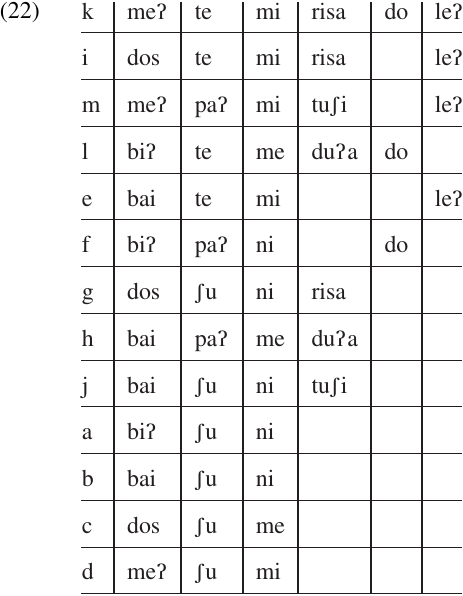
Since–do and–leʔ occur with each other and with elements of every other column in the chart, no further combination is possible. Tense and subject agreement appear to be obligatory, while the other classes are optional, so our final position class chart would look like this:
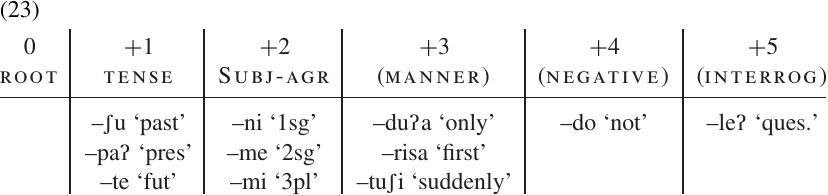
The identification of position classes is not a purely mechanical procedure. It involves judgments based on linguistic knowledge and intuition, which are developed with practice. Moreover, while position class charts are useful for a large number of languages, there are other languages for which they are less helpful.
 الاكثر قراءة في Morphology
 اخر الاخبار
اخبار العتبة العباسية المقدسة

الآخبار الصحية


مواضيع ذات صلة
 قسم الشؤون الفكرية يصدر كتاباً يوثق تاريخ السدانة في العتبة العباسية المقدسة
 "المهمة".. إصدار قصصي يوثّق القصص الفائزة في مسابقة فتوى الدفاع المقدسة للقصة القصيرة
 (نوافذ).. إصدار أدبي يوثق القصص الفائزة في مسابقة الإمام العسكري (عليه السلام)