Exergonic and endergonic reactions
We can express the spontaneity of a reaction at constant temperature and pressure in terms of the reaction Gibbs energy:
If ∆rG<0, the forward reaction is spontaneous.
If ∆rG>0, the reverse reaction is spontaneous.
If ∆rG =0, the reaction is at equilibrium.
A reaction for which ∆rG < 0 is called exergonic (from the Greek words for work producing). The name signifies that, because the process is spontaneous, it can be used to drive another process, such as another reaction, or used to do non-expansion work. A simple mechanical analogy is a pair of weights joined by a string (Fig. 7.2): the lighter of the pair of weights will be pulled up as the heavier weight falls down. Although the lighter weight has a natural tendency to move downward, its coupling to the heavier weight results in it being raised. In biological cells, the oxidation of carbohydrates act as the heavy weight that drives other reactions forward and results in the formation of proteins from amino acids, muscle contraction, and brain activity. A reaction for which ∆rG > 0 is called endergonic (signifying work consuming). The reaction can be made to occur only by doing work on it, such as electrolysing water to reverse its spontaneous formation reaction. Reactions at equilibrium are spontaneous in neither direction: they are neither exergonic nor endergonic.
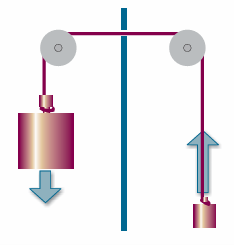
Fig. 7.2 If two weights are coupled as shown here, then the heavier weight will move the lighter weight in its non-spontaneous direction: overall, the process is still spontaneous. The weights are the analogues of two chemical reactions: a reaction with a large negative ∆G can force another reaction with a less ∆G to run in its non-spontaneous direction.








