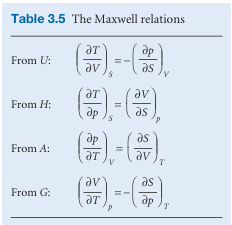
The Maxwell relations
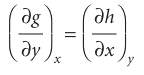
An infinitesimal change in a function f(x,y) can be written df=gdx+hdy where g and hare functions of x and y. The mathematical criterion for df being an exact differential (in the sense that its integral is independent of path) is that
Because the fundamental equation, eqn 3.43, is an expression for an exact differential, the functions multiplying dS and dV(namely T and−p) must pass this test. Therefore, it must be the case that
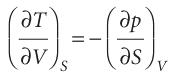
We have generated a relation between quantities that, at first sight, would not seem to be related. Equation 3.47 is an example of a Maxwell relation. However, apart from being unexpected, it does not look particularly interesting. Nevertheless, it does suggest that there may be other similar relations that are more useful. Indeed, we can use the fact that H, G, and Aare all state functions to derive three more Maxwell relations. The argument to obtain them runs in the same way in each case: because H,G, and Aare state functions, the expressions for dH, dG, and dA satisfy relations like eqn 3.47. All four relations are listed in Table 3.5 and we put them to work later in the chapter.