تاريخ الرياضيات

الاعداد و نظريتها
تاريخ التحليل
تار يخ الجبر
الهندسة و التبلوجي
الرياضيات في الحضارات المختلفة
العربية
اليونانية
البابلية
الصينية
المايا
المصرية
الهندية
الرياضيات المتقطعة
المنطق
اسس الرياضيات
فلسفة الرياضيات
مواضيع عامة في المنطق
الجبر
الجبر الخطي
الجبر المجرد
الجبر البولياني
مواضيع عامة في الجبر
الضبابية
نظرية المجموعات
نظرية الزمر
نظرية الحلقات والحقول
نظرية الاعداد
نظرية الفئات
حساب المتجهات
المتتاليات-المتسلسلات
المصفوفات و نظريتها
المثلثات
الهندسة
الهندسة المستوية
الهندسة غير المستوية
مواضيع عامة في الهندسة
التفاضل و التكامل
المعادلات التفاضلية و التكاملية
معادلات تفاضلية
معادلات تكاملية
مواضيع عامة في المعادلات
التحليل
التحليل العددي
التحليل العقدي
التحليل الدالي
مواضيع عامة في التحليل
التحليل الحقيقي
التبلوجيا
نظرية الالعاب
الاحتمالات و الاحصاء
نظرية التحكم
بحوث العمليات
نظرية الكم
الشفرات
الرياضيات التطبيقية
نظريات ومبرهنات
علماء الرياضيات
500AD
500-1499
1000to1499
1500to1599
1600to1649
1650to1699
1700to1749
1750to1779
1780to1799
1800to1819
1820to1829
1830to1839
1840to1849
1850to1859
1860to1864
1865to1869
1870to1874
1875to1879
1880to1884
1885to1889
1890to1894
1895to1899
1900to1904
1905to1909
1910to1914
1915to1919
1920to1924
1925to1929
1930to1939
1940to the present
علماء الرياضيات
الرياضيات في العلوم الاخرى
بحوث و اطاريح جامعية
هل تعلم
طرائق التدريس
الرياضيات العامة
نظرية البيان

Set Covering Deployment
 المؤلف:
ReVelle, C. S. and Rosing, K. E
المؤلف:
ReVelle, C. S. and Rosing, K. E
 المصدر:
"Defendens Imperium Romanum: A Classical Problem in Military Strategy." Amer. Math. Monthly 107
المصدر:
"Defendens Imperium Romanum: A Classical Problem in Military Strategy." Amer. Math. Monthly 107
 الجزء والصفحة:
...
الجزء والصفحة:
...
 19-12-2021
 1995
1995


+
-
20
Set Covering Deployment
Set covering deployment (sometimes written "set-covering deployment" and abbreviated SCDP for "set covering deployment problem") seeks an optimal stationing of troops in a set of regions so that a relatively small number of troop units can control a large geographic region. ReVelle and Rosing (2000) first described this in a study of Emperor Constantine the Great's mobile field army placements to secure the Roman Empire. Set covering deployment can be mathematically formulated as a (0,1)-integer programming problem.
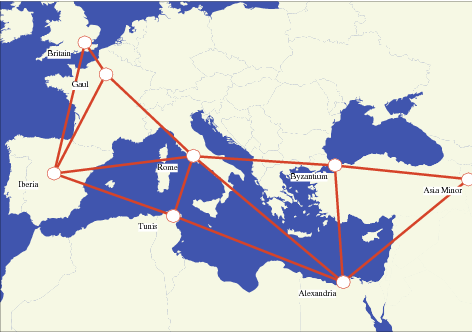
To formulate the Roman domination problem, consider the eight provinces of the Constantinian Roman Empire illustrated above. Each region is represented as a white disk, and the red lines indicate region connections. Call a region secured if one or more field armies are stationed in that region, and call a region securable if a field army can be deployed to that area from an adjacent area. In addition, assume that a field army can only be deployed to an adjacent region if at least one army remains in the original region to provide logistical support. Also assume that each region contains at most two armies, as the number of available armies are limited and cannot be concentrated in any one region.
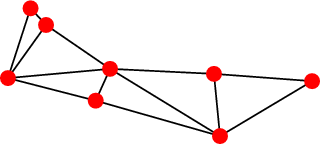
This problem can then be mathematically formulated by representing the Empire as a graph  with vertex set
  and edge set
  . We can then associate two binary variables
  and
and  with each vertex
 (i.e., each province) in the vertex set
  of the Roman Empire graph which specify whether a first and second field army (respectively) is located at a given vertex
  . In the terminology of graph theory, the Roman Empire graph is a simple connected graph on eight vertices and with 13 edges.
In set covering deployment, the problem to be solved is to maximize the quantity  subject to the constraints
 |
(1) |
which guarantees that the first legion is stationed at a given vertex before a second can be,
 |
(2) |
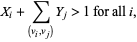
which guarantees that if  does not contain a field army, it has a neighbor with two field armies, and
 |
(3) |
which enforces the integer constraint (i.e., when combined with the first constraint, only zero, one, or two field armies may be placed in any given region). This integer programming problem can then be translated into matrix terms and solved using standard techniques to find the minimum number of field armies needed to secure the Constantinian Roman Empire (ReVelle and Rosing 2000, Rubalcaba 2005).
In the Season 4 opening episode "Trust Metric" (2007) of the television crime drama NUMB3RS, math genius Charlie Eppes uses set covering deployment as an analogy for optimizing the position of police officers in downtown Los Angeles in a search for escaped fugitives.
REFERENCES:
ReVelle, C. S. and Rosing, K. E. "Defendens Imperium Romanum: A Classical Problem in Military Strategy." Amer. Math. Monthly 107, 585-594, 2000.
Rubalcaba, R. R. "Fractional Domination, Fractional Packings, and Fractional Isomorphisms of Graphs." Ph.D. dissertation. Auburn, Alabama: Auburn University. May 13, 2005. http://webpages.uah.edu/~rubalcr/RUBALCABA.pdf.
 الاكثر قراءة في الرياضيات التطبيقية
 اخر الاخبار
اخبار العتبة العباسية المقدسة

الآخبار الصحية


 قسم الشؤون الفكرية يصدر كتاباً يوثق تاريخ السدانة في العتبة العباسية المقدسة
 "المهمة".. إصدار قصصي يوثّق القصص الفائزة في مسابقة فتوى الدفاع المقدسة للقصة القصيرة
 (نوافذ).. إصدار أدبي يوثق القصص الفائزة في مسابقة الإمام العسكري (عليه السلام)