تاريخ الرياضيات

الاعداد و نظريتها
تاريخ التحليل
تار يخ الجبر
الهندسة و التبلوجي
الرياضيات في الحضارات المختلفة
العربية
اليونانية
البابلية
الصينية
المايا
المصرية
الهندية
الرياضيات المتقطعة
المنطق
اسس الرياضيات
فلسفة الرياضيات
مواضيع عامة في المنطق
الجبر
الجبر الخطي
الجبر المجرد
الجبر البولياني
مواضيع عامة في الجبر
الضبابية
نظرية المجموعات
نظرية الزمر
نظرية الحلقات والحقول
نظرية الاعداد
نظرية الفئات
حساب المتجهات
المتتاليات-المتسلسلات
المصفوفات و نظريتها
المثلثات
الهندسة
الهندسة المستوية
الهندسة غير المستوية
مواضيع عامة في الهندسة
التفاضل و التكامل
المعادلات التفاضلية و التكاملية
معادلات تفاضلية
معادلات تكاملية
مواضيع عامة في المعادلات
التحليل
التحليل العددي
التحليل العقدي
التحليل الدالي
مواضيع عامة في التحليل
التحليل الحقيقي
التبلوجيا
نظرية الالعاب
الاحتمالات و الاحصاء
نظرية التحكم
بحوث العمليات
نظرية الكم
الشفرات
الرياضيات التطبيقية
نظريات ومبرهنات
علماء الرياضيات
500AD
500-1499
1000to1499
1500to1599
1600to1649
1650to1699
1700to1749
1750to1779
1780to1799
1800to1819
1820to1829
1830to1839
1840to1849
1850to1859
1860to1864
1865to1869
1870to1874
1875to1879
1880to1884
1885to1889
1890to1894
1895to1899
1900to1904
1905to1909
1910to1914
1915to1919
1920to1924
1925to1929
1930to1939
1940to the present
علماء الرياضيات
الرياضيات في العلوم الاخرى
بحوث و اطاريح جامعية
هل تعلم
طرائق التدريس
الرياضيات العامة
نظرية البيان

Lyapunov Characteristic Exponent
 المؤلف:
Ramasubramanian, K. and Sriram, M. S.
المؤلف:
Ramasubramanian, K. and Sriram, M. S.
 المصدر:
"A Comparative Study of Computation of Lyapunov Spectra with Different Algorithms" 1999. http://arxiv.org/abs/chao-dyn/9909029.
المصدر:
"A Comparative Study of Computation of Lyapunov Spectra with Different Algorithms" 1999. http://arxiv.org/abs/chao-dyn/9909029.
 الجزء والصفحة:
...
الجزء والصفحة:
...
 11-10-2021
 1933
1933


+
-
20
Lyapunov Characteristic Exponent
The Lyapunov characteristic exponent [LCE] gives the rate of exponential divergence from perturbed initial conditions. To examine the behavior of an orbit around a point  , perturb the system and write
 |
(1) |
where  is the average deviation from the unperturbed trajectory at time
  . In a chaotic region, the LCE
  is independent of
  . It is given by the Oseledec theorem, which states that
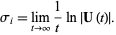 |
(2) |
For an  -dimensional mapping, the Lyapunov characteristic exponents are given by
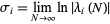 |
(3) |
for  , ...,
  , where
  is the Lyapunov characteristic number.
One Lyapunov characteristic exponent is always 0, since there is never any divergence for a perturbed trajectory in the direction of the unperturbed trajectory. The larger the LCE, the greater the rate of exponential divergence and the wider the corresponding separatrix of the chaotic region. For the standard map, an analytic estimate of the width of the chaotic zone by Chirikov (1979) finds
 |
(4) |
Since the Lyapunov characteristic exponent increases with increasing  , some relationship likely exists connecting the two. Let a trajectory (expressed as a map) have initial conditions
  and a nearby trajectory have initial conditions
  . The distance between trajectories at iteration
  is then
 |
(5) |
and the mean exponential rate of divergence of the trajectories is defined by
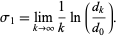 |
(6) |
For an  -dimensional phase space (map), there are
  Lyapunov characteristic exponents
  . However, because the largest exponent
  will dominate, this limit is practically useful only for finding the largest exponent. Numerically, since
  increases exponentially with
  , after a few steps the perturbed trajectory is no longer nearby. It is therefore necessary to renormalize frequently every
  steps. Defining
 |
(7) |
one can then compute
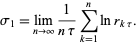 |
(8) |
Numerical computation of the second (smaller) Lyapunov exponent may be carried by considering the evolution of a two-dimensional surface. It will behave as
 |
(9) |
so  can be extracted if
  is known. The process may be repeated to find smaller exponents.
For Hamiltonian systems, the LCEs exist in additive inverse pairs, so if  is an LCE, then so is
  . One LCE is always 0. For a one-dimensional oscillator (with a two-dimensional phase space), the two LCEs therefore must be
  , so the motion is quasiperiodic and cannot be chaotic. For higher order Hamiltonian systems, there are always at least two 0 LCEs, but other LCEs may enter in plus-and-minus pairs
  and
and  . If they, too, are both zero, the motion is integrable and not chaotic. If they are nonzero, the positive LCE
  results in an exponential separation of trajectories, which corresponds to a chaotic region. Notice that it is not possible to have all LCEs negative, which explains why convergence of orbits is never observed in Hamiltonian systems.
Now consider a dissipative system. For an arbitrary  -dimensional phase space, there must always be one LCE equal to 0, since a perturbation along the path results in no divergence. The LCEs satisfy
  . Therefore, for a two-dimensional phase space of a dissipative system,
  . For a three-dimensional phase space, there are three possibilities:
1. (Integrable):  ,
,
2. (Integrable):  ,
,
3. (Chaotic):  .
.
REFERENCES:
Sandri, M. "Numerical Calculation of Lyapunov Exponents." Mathematica J. 6, 78-84, 1996. http://library.wolfram.com/infocenter/Articles/2902/.
Chirikov, B. V. "A Universal Instability of Many-Dimensional Oscillator Systems." Phys. Rep. 52, 264-379, 1979.
Ramasubramanian, K. and Sriram, M. S. "A Comparative Study of Computation of Lyapunov Spectra with Different Algorithms" 1999. http://arxiv.org/abs/chao-dyn/9909029.
Trott, M. The Mathematica GuideBook for Programming. New York: Springer-Verlag, p. 24, 2004. http://www.mathematicaguidebooks.org/.
 الاكثر قراءة في الرياضيات التطبيقية
 اخر الاخبار
اخبار العتبة العباسية المقدسة

الآخبار الصحية


 قسم الشؤون الفكرية يصدر كتاباً يوثق تاريخ السدانة في العتبة العباسية المقدسة
 "المهمة".. إصدار قصصي يوثّق القصص الفائزة في مسابقة فتوى الدفاع المقدسة للقصة القصيرة
 (نوافذ).. إصدار أدبي يوثق القصص الفائزة في مسابقة الإمام العسكري (عليه السلام)