Bernoulli Distribution
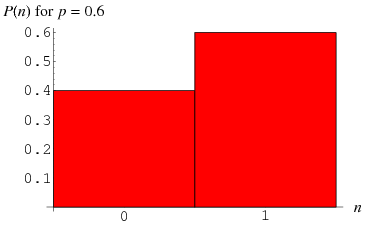
The Bernoulli distribution is a discrete distribution having two possible outcomes labelled by  and
and  in which
  ("success") occurs with probability
  and
and  ("failure") occurs with probability
  , where
  . It therefore has probability density function
![P(n)=<span style=]() {1-p for n=0; p for n=1, " src="https://mathworld.wolfram.com/images/equations/BernoulliDistribution/NumberedEquation1.gif" style="height:41px; width:157px" /> {1-p for n=0; p for n=1, " src="https://mathworld.wolfram.com/images/equations/BernoulliDistribution/NumberedEquation1.gif" style="height:41px; width:157px" /> |
(1)
|
which can also be written
 |
(2)
|
The corresponding distribution function is
![D(n)=<span style=]() {1-p for n=0; 1 for n=1. " src="https://mathworld.wolfram.com/images/equations/BernoulliDistribution/NumberedEquation3.gif" style="height:41px; width:159px" /> {1-p for n=0; 1 for n=1. " src="https://mathworld.wolfram.com/images/equations/BernoulliDistribution/NumberedEquation3.gif" style="height:41px; width:159px" /> |
(3)
|
The Bernoulli distribution is implemented in the Wolfram Language as BernoulliDistribution[p].
The performance of a fixed number of trials with fixed probability of success on each trial is known as a Bernoulli trial.
The distribution of heads and tails in coin tossing is an example of a Bernoulli distribution with  . The Bernoulli distribution is the simplest discrete distribution, and it the building block for other more complicated discrete distributions. The distributions of a number of variate types defined based on sequences of independent Bernoulli trials that are curtailed in some way are summarized in the following table (Evans et al. 2000, p. 32).
| distribution |
definition |
| binomial distribution |
number of successes in  trials trials |
| geometric distribution |
number of failures before the first success |
| negative binomial distribution |
number of failures before the  th success th success |
The characteristic function is
 |
(4)
|
and the moment-generating function is
so
These give raw moments
and central moments
The mean, variance, skewness, and kurtosis excess are then
To find an estimator  for the mean of a Bernoulli population with population mean
  , let
, let  be the sample size and suppose
  successes are obtained from the
  trials. Assume an estimator given by
 |
(22)
|
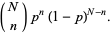
so that the probability of obtaining the observed  successes in
  trials is then
 |
(23)
|
The expectation value of the estimator  is therefore given by
so  is indeed an unbiased estimator for the population mean
  .
.
The mean deviation is given by
 |
(27)
|
REFERENCES:
Evans, M.; Hastings, N.; and Peacock, B. "Bernoulli Distribution." Ch. 4 in Statistical Distributions, 3rd ed. New York: Wiley, pp. 31-33, 2000.








