
الوضع الليلي


 7:3:36
  2026-05-13
  896
896
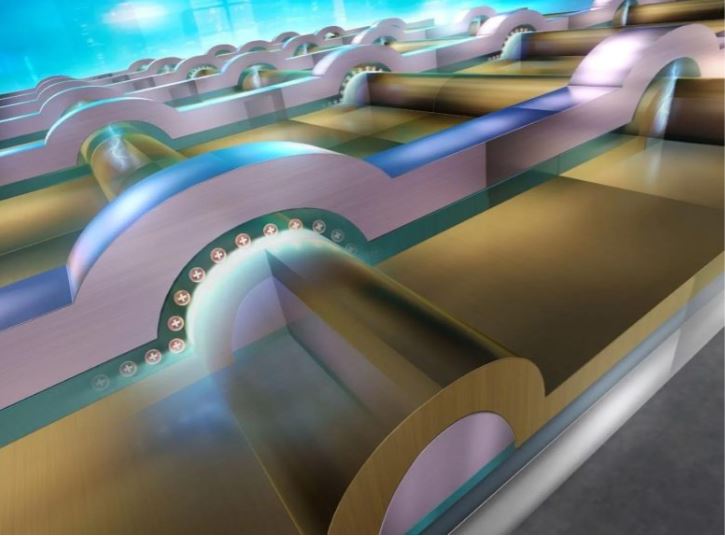
Researchers created a tiny memory device that improves as it gets smaller, breaking a key limitation in electronics. This could lead to longer battery life and more energy-efficient devices.
Have you ever felt your phone heat up after extended use or watched the battery drop at the worst possible time? A major reason is the electronic circuits and memory inside the device, which consume energy and release heat as they work.
Computer memory stores data as 0s and 1s by controlling how easily electricity flows through a material. If scientists can create memory that requires far less electricity, it could significantly reduce the power consumption of smartphones, computers, and other electronics.
Ferroelectric Memory Offers a Low-Power Alternative
One promising idea dates back to 1971 with the introduction of the ferroelectric tunnel junction (FTJ). This type of memory uses ferroelectricity, a property where a material’s internal electric polarization can be reversed. Changing that polarization affects how easily current flows, allowing information to be stored.
However, a major challenge remained. As memory devices were made smaller, traditional materials often lost performance, limiting how far miniaturization could go.
Hafnium Oxide Enables Nanoscale Memory
A key breakthrough came in 2011 when researchers discovered that hafnium oxide, a commonly used material, could maintain its electric polarization even when extremely thin. Building on this finding, Professor Yutaka Majima and his team at the Institute of Science Tokyo (Science Tokyo) set out to develop a memory device just 25 nanometers wide, about one three-thousandth the thickness of a human hair.
Overcoming Leakage in Ultra Small Devices
Shrinking memory to such a tiny scale introduces a serious problem. Electrical current can leak through the boundaries between tiny crystals in the material, which has long prevented further miniaturization.
Rather than avoiding this issue, the researchers took a different approach. They made the device even smaller, which reduced the impact of these boundaries.
They also developed a new method by heating the electrodes so they naturally formed a semicircular shape. This created a structure closer to a single crystal, reducing the number of boundaries where leakage could occur.
A Breakthrough Where Smaller Means Better
By combining this unique structure with extreme miniaturization, the team achieved excellent performance. More importantly, they demonstrated something unexpected. The memory device actually works better as it becomes smaller, challenging long-held assumptions in electronics.
What This Means for Future Technology
If this technology is successfully applied, it could have a major impact on everyday life. Devices like smartwatches could run for months on a single charge, and networks of connected sensors might operate without frequent battery replacements.
In artificial intelligence (AI), this type of memory could allow faster processing while using much less energy. Because hafnium oxide is already compatible with existing semiconductor manufacturing, this new memory could be integrated into common devices in the near future.
Comment from the researcher
“Challenging what seem to be the limits of science—such as ‘we cannot make things any smaller’ or ‘they will break if we do’—is like walking in the dark. It is a continuous struggle,” said Yutaka Majima, Professor, Materials and Structures Laboratory, Institute of Integrated Research, Institute of Science Tokyo. “However, by questioning traditional assumptions and exploring new ways to overcome these barriers, we were able to discover an entirely new perspective. I would be delighted if this achievement sparks the curiosity of young people who will shape the future and helps build a better world.”
Reality Of Islam |
|

A study of

Researchers

MIT enginee
 9:3:43
2018-11-05
9:3:43
2018-11-05
10 benefits of Marriage in Islam
7:5:22
2019-04-08
benefits of reciting surat yunus, hud &
9:45:7
2018-12-24
advantages & disadvantages of divorce
11:35:12
2018-06-10
6:0:51
2018-10-16
7:0:55
2022-05-17
5:58:12
2021-12-18
9:39:36
2022-12-28
3:43:50
2022-11-05
12:10:56
2022-11-17
9:42:16
2022-10-19
2:11:12
2022-10-15
5:41:46
2023-03-18
| LATEST |
 HOME
HOME























