الوضع الليلي


 2:0:37
  2025-10-11
  1970
1970
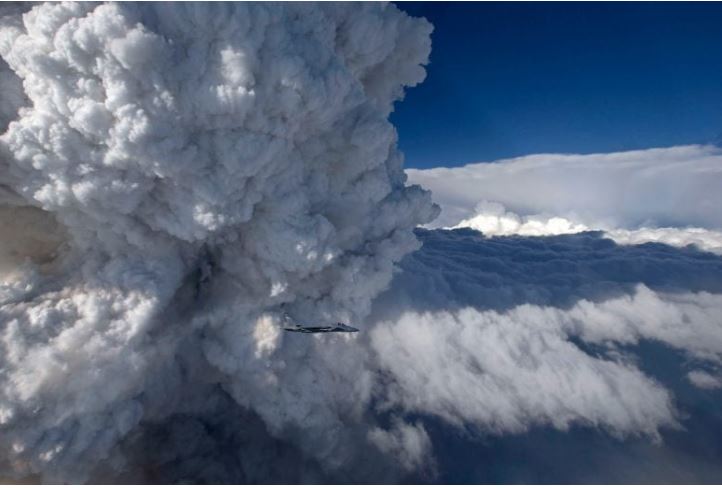
When California’s Creek Fire erupted in 2020, it burned so intensely that it created its own thunderstorm — a towering pyrocumulonimbus cloud that spewed lightning and reshaped the weather above it.
For years, scientists struggled to model these fiery storms that inject smoke and moisture into the atmosphere like volcanic eruptions. Now, researchers have achieved a breakthrough, successfully recreating these self-made storms inside an advanced Earth system model.
Wildfires That Create Their Own Weather
On September 5, 2020, California’s Creek Fire intensified so dramatically that it began to generate its own weather. The fire’s immense heat fueled the rise of a towering thundercloud that unleashed lightning and spread the flames even farther, creating dangerous conditions for firefighters battling the blaze.
These rare storms, born from wildfires, are becoming an increasingly familiar feature of fire seasons across the western United States. They influence everything from air quality to local weather patterns and can even affect the global climate.
Until recently, scientists had been unable to recreate these powerful fire-driven storms in Earth system models, making it difficult to predict when they might form or to measure their larger environmental effects. A new study has now overcome that challenge by introducing an innovative wildfire–Earth system modeling framework.
Breakthrough in Modeling Pyrocumulonimbus Storms
Published on September 25 in Geophysical Research Letters, the research marks the first time scientists have successfully simulated wildfire-generated thunderstorms, known as pyrocumulonimbus clouds, within an Earth system model. Led by DRI researcher Ziming Ke, the team managed to reproduce the timing, height, and intensity of the Creek Fire’s enormous thunderhead—one of the largest of its kind ever recorded in the United States, according to NASA.
The same model also captured the multiple thunderstorms that formed during the 2021 Dixie Fire, even though that event occurred under completely different atmospheric conditions. A crucial part of the study involved representing how moisture carried upward by terrain and winds supports the formation of these towering clouds.
“This work is a first-of-its-kind breakthrough in Earth system modeling,” Ke said. “It not only demonstrates how extreme wildfire events can be studied within Earth system models, but also establishes DRI’s growing capability in Earth system model development — a core strength that positions the institute to lead future advances in wildfire–climate science.”
Why These Fire-Formed Storms Matter for Climate
When a pyrocumulonimbus cloud forms, it injects smoke and moisture into the upper atmosphere at magnitudes comparable to those of small volcanic eruptions, impacting the way Earth’s atmosphere receives and reflects sunlight. These fire aerosols can persist for months or longer, altering stratospheric composition. When transported to polar regions, they affect Antarctic ozone dynamics, modify clouds and albedo, and accelerate ice and snow melt, reshaping polar climate feedbacks.
Scientists estimate that tens to hundreds of these storms occur globally each year, and that the trend of increasingly severe wildfires will only grow their numbers. Until now, failing to incorporate these storms into Earth system models has hindered our ability to understand this natural disturbance’s impact on global climate.
Supercomputers Unlock Fire–Climate Connections
The research team also included scientists from Lawrence Livermore National Laboratory, U.C. Irvine, and Pacific Northwest National Laboratory. Their breakthrough leveraged the Department of Energy’s (DOE) Energy Exascale Earth System Model (E3SM) to successfully capture the complex interplay between wildfires and the atmosphere.
“Our team developed a novel wildfire–Earth system modeling framework that integrates high-resolution wildfire emissions, a one-dimensional plume-rise model, and fire-induced water vapor transport into DOE’s cutting-edge Earth system model,” Ke said. “This breakthrough advances high-resolution modeling of extreme hazards to improve national resilience and preparedness, and provides the framework for future exploration of these storms at regional and global scales within Earth system models.”
Reality Of Islam |
|
Plants are

After spend
A study of

Researchers
 9:3:43
2018-11-05
9:3:43
2018-11-05
10 benefits of Marriage in Islam
7:5:22
2019-04-08
benefits of reciting surat yunus, hud &
9:45:7
2018-12-24
advantages & disadvantages of divorce
11:35:12
2018-06-10
6:0:51
2018-10-16
the happy life of mankind requirement
6:36:36
2022-01-25
1:34:8
2022-02-01
3:43:50
2022-11-05
8:21:9
2018-06-21
5:58:12
2021-12-18
2:2:13
2022-10-08
7:32:24
2022-02-14
5:41:46
2023-03-18
| LATEST |
 HOME
HOME