الوضع الليلي


 5:51:3
  2025-06-23
  2179
2179
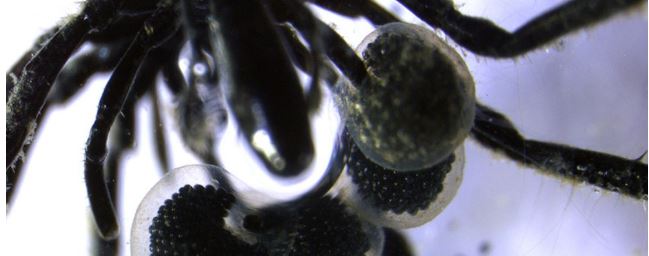
Three newly-discovered species of deep sea 'spiders' farm methane-eating bacteria on their own bodies in a symbiosis quite unlike anything seen before.
Unlike animals like ourselves, who are fed by a solar-powered food chain, those that live in the deep sea have to get creative with their energy sources. Sunlight is scattered and absorbed as it travels through ocean water, and never reaches depths beyond 1,000 meters (around 3,300 feet).
And yet, many creatures have successfully set up shop where the sun don't shine.
Sea spiders are marine arthropods that inhabit these dark waters, but their name is misleading: they're not actually spiders, or even arachnids. The resemblance comes from their tiny bodies, from which four to six pairs of legs radiate.
Discovered by a team led by Bianca Dal Bó from Occidental College in the US, these new sea spider species (scientific names pending) are all members of the genus Sericosura. They also all live exclusively on methane seeps, where the potent greenhouse gas leaks from the seafloor.
Remote-operated vehicle dives in 2021 and 2023 collected the sea spider specimens from within 25 meters of two seeps off the coast of Southern California – the Palos Verdes seep (397 meters below sea level), and the Del Mar seep (1,018 meters below sea level) – and the Sanak seep in Alaska, 2,020 meters underwater.
Growing upon the exoskeletons of all three species the team found densely-packed arrays of three kinds of bacteria known to turn methane and methanol into carbon and energy. The finding could explain why the sea spiders never ventured far from the seeps; they were depending on the bacteria for food.
Sea lab experiments confirmed the researcher's suspicions. By tagging methane and carbon dioxide with distinct carbon isotopes and then exposing the sea spiders to these gases, the researchers could trace each isotope's passage through the microcosm.
"Nearly all sea spider-associated MMOx bacterial cells assimilated carbon from either methane or methanol, but not CO2," the researchers report.
"Within five days, sea spider digestive tissues also showed significant incorporation of the [carbon isotope] label, a phenomenon that could only have occurred via consumption of methane-oxidizing bacteria."
And unlike animals in methane-dependent lake ecosystems, the sea spiders seem to cultivate and consume their methanophilic bacteria directly from their bodies. Being stuck on the seeps may be a worthy trade-off.
Other methane-seep animals have adopted similar arrangements with these particular groups of live-in bacteria. Sea sponges, sabellid worms, and beard worms host a primary symbiosis with one type; beard worms and mussels have a secondary symbiosis with another; and the third kind of bacteria has been found living on the exoskeleton of a hydrothermal vent crab.
"To date, however, no single animal species has been shown to host all three [methane- and methanol-oxidizing] families," the authors note.
Despite the vast distances between the Alaskan and Southern Californian seeps, the sea spiders' bacterial 'gardens' were functionally identical, regardless of which seep they were found at.
The researchers suspect the bacteria may be passed down through generations. The male sea spiders carry and brood egg sacs for up to 20 days, and despite their youth, the eggs already hosted a similarly methane-loving microbiome. When the baby sea spiders hatch, that bacteria provides an immediate source of food that they will cultivate for life.
Half of the Del Mar seep specimens were males, and all of them were carrying eggs. This is an unprecedented level of fertility for sea spider sightings, which may be a sign that the methane-eating bacteria farm is paying off.
It's a humbling reminder of how many different strategies for survival the Earth has hidden up even its deepest, darkest sleeves.
Reality Of Islam |
|
Plants are
After spend
A study of
Researchers
 9:3:43
2018-11-05
9:3:43
2018-11-05
10 benefits of Marriage in Islam
7:5:22
2019-04-08
benefits of reciting surat yunus, hud &
9:45:7
2018-12-24
advantages & disadvantages of divorce
11:35:12
2018-06-10
6:0:51
2018-10-16
8:25:12
2022-03-09
11:11:59
2023-02-01
12:47:1
2022-12-20
al-hussain (peace be upon him)
10:18:1
2022-09-21
10:35:40
2022-05-26
4:2:19
2022-10-10
8:19:41
2018-06-21
5:41:46
2023-03-18
| LATEST |
 HOME
HOME