
الوضع الليلي


 9:51:54
  2024-03-18
  2112
2112
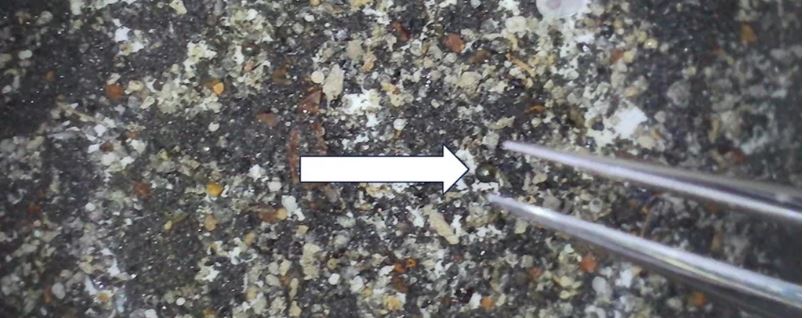
Our Solar System does not exist in isolation. It formed within a stellar nursery along with hundreds of sibling stars, and even today has the occasional interaction with interstellar objects such as Oumuamua and Borisov. So it's reasonable to presume that some interstellar material has reached Earth.
Recently Avi Loeb and his team earned quite a bit of attention with a study arguing that it had found some of this interstellar stuff on the ocean seabed. But a new study finds that the material has a much more local origin.
The original study is based on a 2014 meteor that entered the Earth's atmosphere off the coast of Papua New Guinea. Observations of its impact trajectory suggested it might have been extraterrestrial in origin. And since we had an idea of where it hit, why not look for its debris?
This led Loeb's team to the seafloor near Papua New Guinea, where they found small, iron-rich spheres known as spherules. The study analyzed the composition of these spherules and found the isotope distribution was so unusual they must have an interstellar origin.
While that sounds compelling, there are a few caveats. The first is that the trajectory of the 2014 meteor isn't that precisely known. We know the general impact region, but the data simply isn't good enough to prove that these spherules came from this particular meteor.
The second is that "unusual" isotopes aren't uncommon within our Solar System. As the new study shows, there is a distribution of iron isotope ratios for objects originating in the solar system, specifically the ratios of 57Fe and 56Fe.
The ratio for the "alien" spherules is well within that range. So well that the odds of them being interstellar is less than 1 in 10,000. So these spherules have a local origin.
But they were likely formed from an impact event, so this new study went further. Is there a known impact from which these spherules originated? Turns out there is.
The region in which they were found is part of what's known as the Australasian tektite strewn field. It is a vast field that spans southeast Asia to Antarctica and was caused by a large impact 790,000 years ago. The team looked at other isotope ratios and found they are consistent with other known Australasian tektites.
So these particular spherules have a local origin. But that doesn't mean interstellar meteorites don't exist. Given what we know, there are almost certainly interstellar objects on Earth just waiting to be found. We just have to keep looking for them.
Reality Of Islam |
|

A study of

Researchers

MIT enginee
 9:3:43
2018-11-05
9:3:43
2018-11-05
10 benefits of Marriage in Islam
7:5:22
2019-04-08
benefits of reciting surat yunus, hud &
9:45:7
2018-12-24
advantages & disadvantages of divorce
11:35:12
2018-06-10
6:0:51
2018-10-16
9:39:36
2022-12-28
5:57:34
2023-03-18
9:30:2
2021-11-12
10:35:40
2022-05-26
6:28:21
2022-12-20
1:34:8
2022-02-01
7:26:19
2022-04-08
5:41:46
2023-03-18
| LATEST |
 HOME
HOME























