
الوضع الليلي


 3:16:30
  2023-08-06
  1547
1547
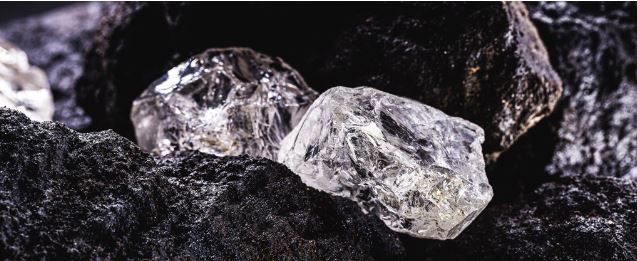
"A diamond is forever." That iconic slogan, coined for a highly successful advertising campaign in the 1940s sold the gemstones as a symbol of eternal commitment and unity.
But our new research, carried out by researchers in a variety of countries and published in Nature, suggests that diamonds may be a sign of break up too - of Earth's tectonic plates, that is. It may even provide clues to where is best to go looking for them.
Diamonds, being the hardest naturally-occurring stones, require intense pressures and temperatures to form. These conditions are only achieved deep within the Earth. So how do they get from deep within the Earth, up to the surface?
Diamonds are carried up in molten rocks, or magmas, called kimberlites. Until now, we didn't know what process caused kimberlites to suddenly shoot through the Earth's crust having spent millions, or even billions, of years stowed away under the continents.
Supercontinent cycles
Most geologists agree that the explosive eruptions that unleash diamonds happen in sync with the supercontinent cycle: a recurring pattern of landmass formation and fragmentation that has defined billions of years of Earth's history
However, the exact mechanisms underlying this relationship are debated. Two main theories have emerged.
One proposes that kimberlite magmas exploit the "wounds" created when the Earth's crust is stretched or when the slabs of solid rock covering the Earth - known as tectonic plates - split up. The other theory involves mantle plumes, colossal upwellings of molten rock from the core-mantle boundary, located about 2,900km beneath the Earth's surface.
In addition, many kimberlites don't display the chemical "flavours" we'd expect to find in rocks derived from mantle plumes.
In contrast, kimberlite formation is thought to involve exceedingly low degrees of mantle rock melting, often less than 1%. So, another mechanism is needed. Our study offers a possible resolution to this longstanding conundrum.
We deployed statistical analysis, including machine learning - an application of artificial intelligence (AI) - to forensically examine the link between continental breakup and kimberlite volcanism. The results of our global study showed the eruptions of most kimberlite volcanoes occurred 20 to 30 million years after the tectonic breakup of Earth's continents.
Furthermore, our regional study targeting the three continents where most kimberlites are found - Africa, South America and North America - supported this finding. It also added a major clue: kimberlite eruptions tend to gradually migrate from the continental edges to the interiors over time at a rate that is uniform across the continents.
This begs the question: what geological process could explain these patterns? To address this question, we employed multiple computer models to capture the complex behaviour of continents as they experience stretching, alongside the convective movements within the underlying mantle.
Domino effect
We propose that a domino effect can explain how breakup of the continents eventually leads to formation of kimberlite magma. During rifting, a small region of the continental root - areas of thick rock located under some continents - is disrupted and sinks into the underlying mantle.
Here, we get sinking of colder material and upwelling of hot mantle, causing a process called edge-driven convection. Our models show that this convection triggers a chain of similar flow patterns that migrate beneath the nearby continent.
Our models show that while sweeping along the continental root, these disruptive flows remove a substantial amount of rock, tens of kilometres thick, from the base of the continental plate.
Various other results from our computer models then advance to show that this process can bring together the necessary ingredients in the right amounts to trigger just enough melting to generate gas-rich kimberlites. Once formed, and with great buoyancy provided by carbon dioxide and water, the magma can rise rapidly to the surface carrying its precious cargo.
Finding new diamond deposits
This model doesn't contradict the spatial association between kimberlites and mantle plumes. On the contrary, the breakup of tectonic plates may or may not result from the warming, thinning and weakening of the plate caused by plumes.
However, our research clearly shows that the spatial, time-based and chemical patterns observed in most kimberlite-rich regions can't be adequately explained solely by the presence of plumes.
The processes triggering the eruptions that bring diamonds to the surface appear to be highly systematic. They start on the edges of continents and migrate towards the interior at a relatively uniform rate.
This information could be used to identify the possible locations and timings of past volcanic eruptions tied to this process, offering insights that could enable the discovery of diamond deposits and other rare elements needed for the green energy transition.
If we are to look for new deposits, it's worth bearing in mind that there are currently efforts by campaign groups to try to eliminate from world markets those diamonds that are used to find wars (conflict diamonds) or those coming from mines with poor conditions for workers.
Diamonds may or may not be forever, but our work shows that new ones have been repeatedly created over long periods in the history of our planet.
Reality Of Islam |
|

A study of

Researchers

MIT enginee
 9:3:43
2018-11-05
9:3:43
2018-11-05
10 benefits of Marriage in Islam
7:5:22
2019-04-08
benefits of reciting surat yunus, hud &
9:45:7
2018-12-24
advantages & disadvantages of divorce
11:35:12
2018-06-10
6:0:51
2018-10-16
al-hussain (peace be upon him)
10:18:1
2022-09-21
8:15:37
2023-02-16
11:34:48
2022-06-29
2:34:48
2022-01-18
8:30:23
2022-03-03
6:14:3
2023-01-18
11:2:27
2022-10-06
5:41:46
2023-03-18
| LATEST |
 HOME
HOME























