الوضع الليلي


 4:47:16
  2019-08-04
  1578
1578
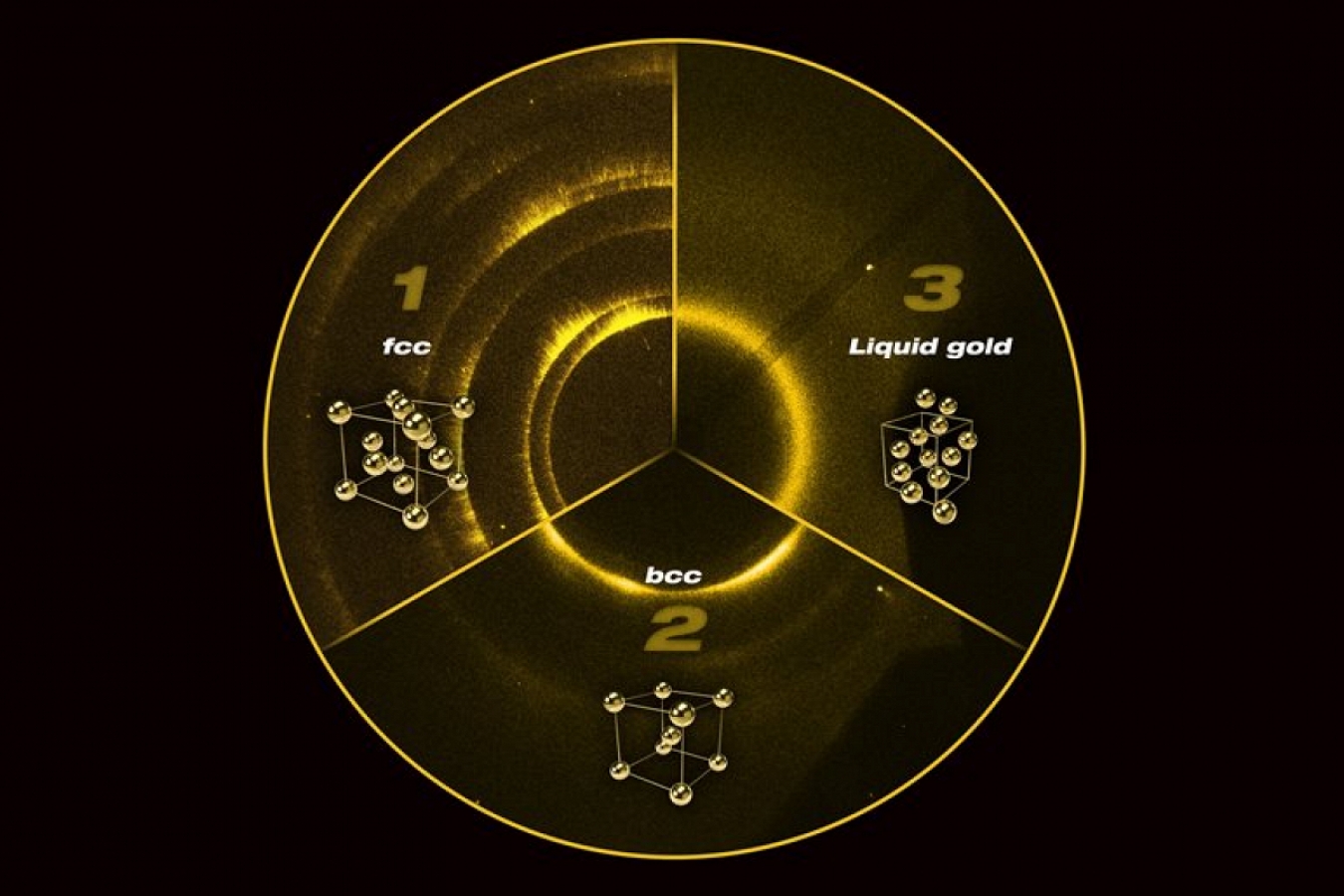
Under extreme conditions, gold rearranges its atoms and forms a previously unknown structure. And when the pressures were pushed to the equivalent of those at the center of the Earth, the gold got even weirder.
The finding comes from a new study in which researchers from the Lawrence Livermore National Laboratory (LLNL) and the Carnegie Institution for Science practiced their 21st-century alchemy at the Argonne National Laboratory in Illinois. Using a high-energy laser, they heated gold to extreme temperatures and compressed it to pressures as high as those found at the center of the Earth.
More specifically, they put a little piece of plastic in front of a chunk of gold and then shot a high-energy laser through the plastic, which "basically causes an explosion that sends plastic one way and shock waves in the opposite direction," said lead author Richard Briggs, a postdoctoral scientist at LLNL.
Those shock waves hit the gold and caused it to compress and heat up extremely quickly, within nanoseconds. They then hit the gold with X-rays and detected where the x-rays bounced off in order to figure out its structure. This is "the first time that we've ever been able to reach such high-pressure and high-temperature conditions and look at them at the same time using X-rays," Briggs told Live Science. What they saw was "certainly a surprise."
Gold usually forms a crystalline structure that materials scientists call face-centered cubic (fcc). Imagine a cube like a die. Atoms would sit on each corner and each face, Briggs said. But most experiments conducted on gold have involved compressing it slowly and at room temperature, he added.
Because it so loyally forms this face-centered cubic structure, gold has been used as a kind of "standard" in high-pressure experiments to calculate pressure, Briggs said. But when Briggs and his team rapidly compressed the gold at high temperatures, it formed what's called the body-centered cubic (bcc) structure. This more-open structure packs atoms into a space in a less-efficient way, which means the gold doesn't prefer to be in this form, he said. If you were to imagine the die again, it would be as if atoms sat on each corner, with just one atom in the middle.
The finding that gold can form this new structure may change the way scientists use the element as a standard in high-pressure experiments, Briggs said.
The team found that the structure of gold began to change from fcc to bcc at around 220 gigapascals (GPa), which is 2.2 million times our planet's atmospheric pressure, the researchers said in a statement. What's more, when the researchers compressed the gold beyond 250 GPa to pressures equivalent to that found at the center of the Earth (around 330 GPa), it melted.
Reality Of Islam |
|
A study of

Researchers

MIT enginee
 9:3:43
2018-11-05
9:3:43
2018-11-05
10 benefits of Marriage in Islam
7:5:22
2019-04-08
benefits of reciting surat yunus, hud &
9:45:7
2018-12-24
advantages & disadvantages of divorce
11:35:12
2018-06-10
6:0:51
2018-10-16
2:42:26
2023-02-02
11:2:27
2022-10-06
allah will not answer all your prayers
6:56:28
2022-01-01
6:0:8
2023-03-19
a hero waters thirsty wild animals
9:4:9
2022-01-06
7:32:24
2022-02-14
9:42:16
2022-10-19
5:41:46
2023-03-18
| LATEST |
 HOME
HOME